Is AI Art Copyrighted? What Artists Need to Know in 2026
Last Updated: 2026-01-22 18:07:32
If you've been creating art with Midjourney, DALL-E, or Stable Diffusion, you've probably wondered whether your AI generated artwork is protected by copyright. It's a question that matters especially if you're selling prints, building a portfolio, or worried about someone copying your work.
The answer isn't straightforward, and it's evolved significantly over the past two years. This guide breaks down what's actually copyrightable when it comes to AI art, based on recent court decisions and the U.S. Copyright Office's latest guidance from January 2025.
Quick Answer
Pure AI generated art where you simply type a prompt and the AI creates the image that cannot be copyrighted under current U.S. law.
The Copyright Office has been clear on this: copyright requires human authorship, and text prompts alone don't meet that standard.
But here's where it gets interesting. If you've put substantial creative work into your AI art beyond just prompting through selection, arrangement, editing, or combining AI outputs with your own original elements those human contributions can potentially be copyrighted.
Think of it this way: the AI generated parts remain unprotected, but the creative work you add on top might qualify for protection.
Why Text Prompts Aren't Enough
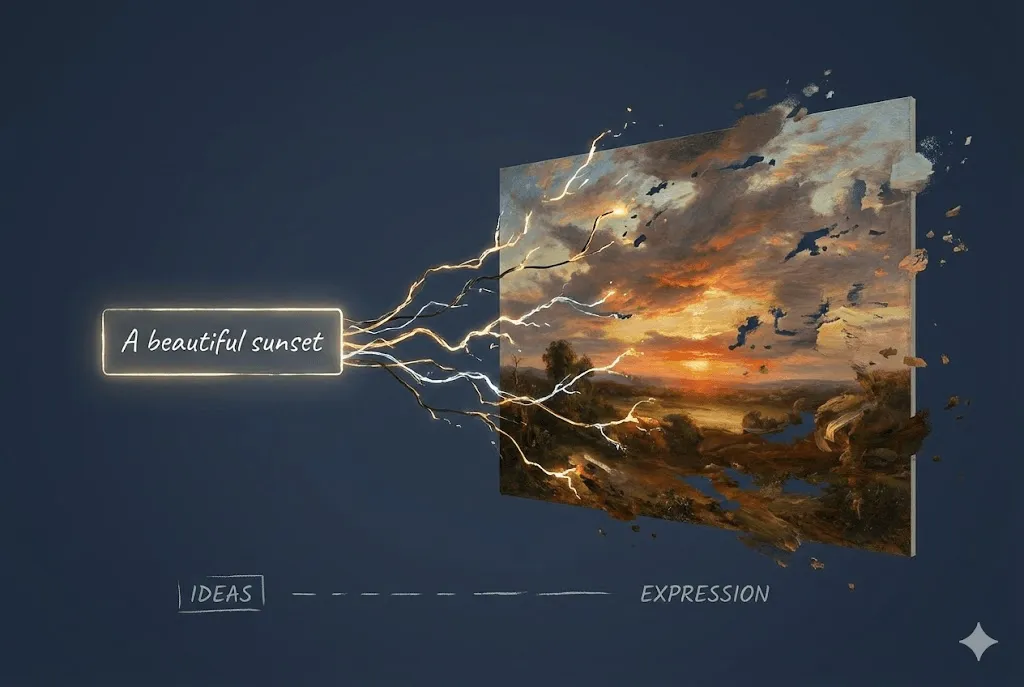
This is probably the most controversial part of current AI art copyright law, and it catches a lot of creators off guard. You might spend hours crafting the perfect prompt, iterating through hundreds of variations, fine tuning every word and the Copyright Office still says it's not enough for copyright protection.
Their reasoning comes down to control and predictability. When you commission a human artist and give them detailed instructions, that artist is still making countless creative decisions about composition, color, style, lighting, and execution. You're directing the concept, but they're creating the expression.
The Copyright Office views AI tools similarly. In their January 2025 report on AI copyrightability, they explicitly stated that "prompts alone do not provide sufficient human control to make users of an AI system the authors of the output." Even if you write a 500 word prompt, the AI is still making the actual creative decisions about how to render that concept into an image.
The analogy they use is instructive: you're more like a client giving directions than an artist creating the work. And copyright law has always distinguished between the person who has the idea and the person who actually creates the expression of that idea.
The Théâtre D'opéra Spatial Case
Jason Allen found this out the hard way. His AI generated artwork won first place at the 2022 Colorado State Fair fine art competition which made national news when people learned it was created using Midjourney. Allen had put significant effort into the piece, using over 600 different prompts and spending weeks refining his approach.
When he applied for copyright registration, the Copyright Office denied it in September 2023. Despite his extensive prompt engineering process, they ruled he hadn't exercised sufficient creative control over the final output. The AI had made the actual creative decisions about how to visualize his prompts.
This case really crystallized the Copyright Office's position: no matter how sophisticated your prompting technique, it's not enough by itself.
What Actually Is Copyrightable
So if pure AI outputs aren't copyrightable, what is? Based on recent Copyright Office decisions and registrations, there are several scenarios where AI assisted art can receive protection.
Human Selection and Arrangement
The first successful case came in February 2023 with Kris Kashtanova's graphic novel Zarya of the Dawn. Kashtanova had used Midjourney to generate images for the novel, and initially received a copyright registration for the entire work. But after the Copyright Office learned about the AI involvement, they took a closer look.
The outcome was nuanced: Kashtanova retained copyright for the text (which was entirely human written) and for the selection, coordination, and arrangement of the images and text together. But the individual AI generated images themselves? Not copyrightable.
This established an important principle. If you're curating, selecting, and arranging multiple AI generated elements whether in a larger work like a graphic novel or in a single composition your creative choices in that process can be protected. You're not copyrighting the AI outputs themselves, but rather your original compilation of them.
Substantial Human Modification
The Copyright Office has also indicated that if you take AI generated content and modify it substantially, those modifications can be copyrightable. But we're not talking about minor tweaks or applying filters. They mean significant creative changes that reflect your personal artistic judgment.
In practice, this might mean:
- Taking an AI generated image and substantially painting over it or redrawing major elements
- Using AI output as a starting point but making creative decisions that fundamentally change the composition, style, or expression
- Combining multiple AI elements with substantial manual editing that creates something genuinely new
The key question the Copyright Office asks is whether a human made the creative decisions that resulted in the final work's expression, or whether the AI did. If it's genuinely unclear where the AI ends and your work begins and your contribution is substantial you're in stronger territory for copyright protection.
AI as a Tool in Human Creation
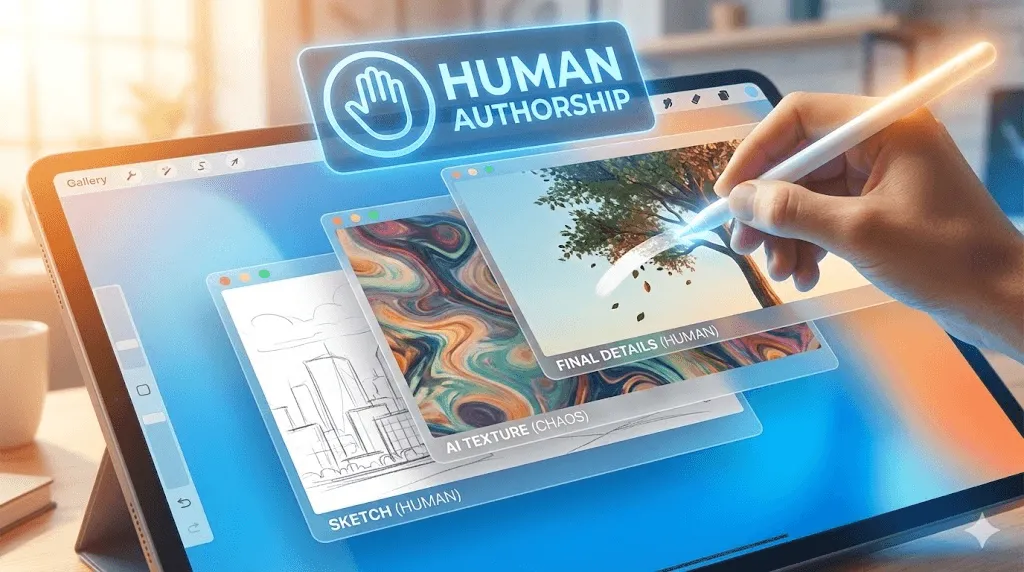
This is the clearest path to copyright protection. If you use AI the way you might use Photoshop or a digital brush as one tool among many in a predominantly human creative process your work can be fully copyrightable.
Say you sketch a character by hand, scan it, use an AI tool to help with texture generation or color palette exploration, then do the final rendering yourself with manual digital painting. The AI's contribution is incidental to your creative process. You're the author, and the fact that you used AI assistance doesn't change that, any more than using Photoshop would.
The Copyright Office has registered hundreds of works that incorporate some AI generated material when the human authorship is clear and substantial. It's about the degree of human creative control over the final expression.
The Landmark Court Ruling: Thaler v. Perlmutter
In March 2025, the D.C. Circuit Court of Appeals issued what's likely to be the definitive ruling on AI authorship for some time. Dr. Stephen Thaler had created an AI system called the Creativity Machine, which generated an artwork titled "A Recent Entrance to Paradise." He sought copyright registration listing the AI as the sole author (with himself as the claimant).
The Copyright Office denied the application, and Thaler sued. The case wound its way through the courts, and in March 2025, the appeals court affirmed that human authorship is a "bedrock requirement" of copyright law. AI systems cannot be authors, period.
The court's reasoning was straightforward: Congress intended copyright to incentivize human creativity. Machines don't need incentives to create. The constitutional basis for copyright (in the Copyright Clause) speaks of "Authors," which has consistently been interpreted to mean humans. And accepting AI authorship would fundamentally reshape copyright law in ways Congress never contemplated.
This ruling removes any lingering ambiguity: under current law, AI cannot be an author. Copyright requires a human.
Can You Sell AI Art?
Here's where things get practical. Yes, you can absolutely sell AI generated art. There's no law preventing you from selling images created by AI tools. People are successfully selling AI art as prints, on merchandise, as NFTs, and through various other channels.
But and this is crucial if your art is pure AI output without substantial human authorship, you can't copyright it. Which means you can't prevent others from copying it or creating something very similar.
Think of it this way: you can sell the physical print or the file, but you can't prevent someone else from using the same prompt to generate a similar image, or from copying your AI generated work outright. You have no legal recourse through copyright law because the work isn't protected.
This creates an interesting market dynamic. Your competitive advantage comes from being first to market, from your marketing and brand, from your ability to consistently produce quality work but not from legal exclusivity through copyright.
Platform Policies Matter
Different selling platforms have different rules about AI content, and they're stricter than basic copyright law:
Etsy has taken a firm stance. They require that items in their marketplace have human creative input. A direct AI output without modification violates their policies. You need to add something whether that's your own artwork combined with the AI generation, substantial editing, or using AI as part of a larger handmade creation process.
Print on demand services like Redbubble and Printful generally allow AI art, but you need to ensure you have the rights to use any training data that went into the model. This is trickier than it sounds, since most AI tools don't disclose their training data. The practical advice: avoid generating images that obviously mimic copyrighted characters or specific artists' distinctive styles.
NFT marketplaces like OpenSea don't ban AI art, but there's increasing pressure to disclose when work is AI generated. The NFT community values authenticity and provenance, so transparency about your creative process tends to be good practice regardless of the legal requirements.
Commercial Rights from AI Platforms
Your AI tool's terms of service matter as much as copyright law here. Midjourney, for example, grants commercial rights to paying subscribers but not to free trial users. If you're on the $10/month plan or higher, you can use your generated images commercially. But read the terms carefully and they can change.
OpenAI's DALL-E gives commercial rights to paying users, and you can use the images for merchandise, marketing, or other business purposes. They assign you the rights to the images you generate.
Stable Diffusion operates under open source licenses that generally allow commercial use, but the specific terms depend on which model you're using and where you're running it.
Important caveat: these platforms can grant you usage rights and licenses, but they can't create copyright protection where federal law doesn't recognize it. That's a separate question.
Making Your AI Art More Copyrightable
If you want copyright protection for your AI assisted artwork, you need to demonstrate substantial human creative authorship. Here are practical approaches:
The most straightforward method is to use AI as one tool in a broader creative process. Start with your own sketches or photographs. Use AI to generate elements, textures, or references. Then do significant creative work integrating, modifying, and finalizing everything. The more your personal creative decisions shape the final result, the stronger your copyright claim.
Another approach is the compilation method. Generate multiple AI images, then exercise creative judgment in selecting specific elements and arranging them into a new composition. Add your own original elements text, borders, hand drawn additions, photographic elements. The selection and arrangement can be copyrightable even if the underlying AI pieces aren't.
If you're doing this, documentation helps. Keep your layer files, save work in progress versions, maintain notes about your creative decisions. If you ever need to register copyright, this evidence of your creative process will be valuable.
The key principle is that human contribution needs to be substantial, not trivial. Applying a filter or making minor color adjustments probably isn't enough. But if you're making real creative decisions that shape the final expression through composition, modification, integration with original work, or creative arrangement you're building a case for copyright protection.
Registering Copyright for AI Assisted Work
If you've created something with substantial human authorship, you can register it with the U.S. Copyright Office. But you need to be upfront about the AI involvement.
When you fill out the registration form (Form VA for visual arts), you'll need to clearly identify what parts are human authored and what's AI generated. In the "Author Created" field, describe only your contributions: "selection and arrangement," "digital painting and composition," "photographic elements and manual editing" whatever actually applies.
There's a section for limiting your claim. This is where you explicitly exclude the AI generated portions: "Registration does not extend to AI generated background elements" or something similar.
The Copyright Office may come back with questions. They might ask for more details about your creative process or clarification about which elements are AI generated. This is normal . They're trying to understand where human authorship exists in the work.
Processing times are currently running 3 10 months. If they reject your application, you'll have an opportunity to respond and clarify. Some rejections get overturned when creators provide more documentation of their human creative input.
One practical note: the Copyright Office can't always tell what's AI generated just by looking at an image. But you're required to disclose it honestly in your application. Failing to do so and later being found out can invalidate your registration.
The Training Data Question
There's a parallel copyright controversy that affects AI art creators: the question of whether AI companies violate copyright by training their models on copyrighted images.
Several major lawsuits are working through the courts right now. Artists have sued Stability AI (makers of Stable Diffusion), arguing that the company infringed their copyrights by training on their work without permission. Getty Images has a similar lawsuit, claiming Stability AI scraped millions of their copyrighted images for training.
The AI companies' defense centers on fair use. They argue that training is transformative the model learns patterns but doesn't store or reproduce the original images. They say it's analogous to a human artist studying other artists' work to learn techniques.
Courts haven't definitively ruled on this yet, and the outcomes will significantly impact the AI art industry. If training on copyrighted work is found to be infringement, AI companies might need to license training data or use only public domain and licensed content. That could change which AI tools are available and how they work.
For creators using these tools, practical advice is to avoid prompts that obviously aim to reproduce copyrighted characters or mimic specific artists' distinctive styles. Asking for "Spider Man" or "in the style of [specific living artist]" creates more legal exposure than generic style descriptors.
International Differences
U.S. law is relatively strict on the human authorship requirement, but other countries take different approaches.
The UK's copyright law includes provisions for "computer generated works" that might offer broader protection. Their law grants copyright to "the person by whom the arrangements necessary for the creation of the work are undertaken." This potentially gives copyright to the person operating the AI tool, though case law is still developing.
Canada has taken an interesting approach in some cases. The Canadian Intellectual Property Office registered the artwork "SURYAST" which was denied copyright in the U.S. and recognized the AI system as a co-author alongside the human creator. This is a fundamentally different framework.
China has issued court rulings in some cases recognizing copyright in AI generated content when human input is demonstrated, though they focus more on whether the work is original than on strict human authorship.
The EU generally follows human authorship requirements similar to the U.S., though implementation varies by member state. The EU's recent AI Act focuses more on regulating AI systems than on copyright specifics.
If you're selling or licensing AI art internationally, the copyright status might differ depending on the jurisdiction. This is one reason why consultation with an IP attorney can be valuable for serious commercial ventures.
What's Coming Next
The legal framework for AI art is still evolving. The Copyright Office stated in January 2025 that they don't believe new legislation is needed right now they think existing copyright law can handle AI related questions through case by case analysis and court precedents.
But Congress has shown interest in the topic. Multiple hearings have addressed AI and copyright, and legislation could emerge if courts or the Copyright Office's case by case approach doesn't provide adequate clarity.
Technology is also evolving. As AI tools become more sophisticated and offer users greater control over outputs, the line between "tool" and "creator" might become clearer. Future AI systems might allow such precise control that they're unambiguously just tools used by human authors.
Industry solutions are developing too. Some platforms are experimenting with blockchain based verification of creative processes and human authorship. Technical standards for identifying and watermarking AI generated content are in development.
The training data lawsuits will also shape the landscape. Depending on how courts rule on fair use and training, we might see collective licensing systems emerge similar to how music streaming services license catalogs to compensate artists whose work trains AI systems.
For now, the safe approach is to treat AI as a powerful tool in your creative process rather than as a replacement for human creativity. The more your personal creative decisions shape the final work, the more legally protected it will be.
Common Questions
Can I copyright AI art if I spent hours on the prompt? No. The Copyright Office has been clear that prompt engineering alone even extensive, sophisticated prompting doesn't constitute sufficient human authorship. You need direct creative involvement in shaping output.
What if I modify the AI output slightly? Minor modifications like color adjustments or filters probably aren't enough. You need substantial creative changes that reflect genuine human artistic judgment. Think major compositional changes, significant painting or drawing on top, or creative integration with original human created elements.
Can I sell AI art on Etsy? Etsy requires human creative input beyond pure AI generation. You need to add something original whether that's combining AI elements with your artwork, substantial modification, or using AI as part of a larger handmade creative process.
Is AI art in the public domain? Not exactly. AI generated content isn't copyrightable, which means it lacks copyright protection, but "public domain" traditionally refers to works where copyright has expired or never existed for other reasons. The practical effect is similar . Anyone can use it, but the legal status is slightly different.
What about NFTs of AI art? You can absolutely mint and sell AI art as NFTs. But remember that if it's pure AI output, you can't prevent others from creating identical or nearly identical pieces using similar prompts. Your value comes from being first, from your marketing, or from additional creative elements you add not from legal exclusivity through copyright.
Bottom Line
Creating art with AI tools is legal, selling it is legal, and technology opens up incredible creative possibilities. But if you want copyright protection, the legal ability to prevent others from copying your work, you need to go beyond simple prompting.
Use AI as a tool in a larger creative process. Add substantial human creative input through selection, arrangement, modification, or integration with your original work. Document your process. And be honest when registering copyright about which parts are AI generated.
The legal landscape is still developing, and today's guidance might evolve as courts issue new rulings and technology advances. For now, the central principle remains: copyright requires human authorship, and the more your creative decisions shape the final work, the stronger your copyright protection.
If you're building a business around AI art, consider it one tool in your creative toolkit rather than a shortcut around the creative process. That approach will serve you well both legally and artistically.
Sources and Further Reading:
- U.S. Copyright Office, "Copyright and Artificial Intelligence, Part 2: Copyrightability" (January 2025)
- Thaler v. Perlmutter, No. 22 5341 (D.C. Cir. 2025)
- U.S. Copyright Office, "Copyright Registration Guidance: Works Containing Material Generated by Artificial Intelligence" (March 2023)
- Review Board Decisions on Zarya of the Dawn, Théâtre D'opéra Spatial, and SURYAST (2023)
This article reflects U.S. law as of March 2025. Copyright law evolves, particularly regarding emerging technologies. For specific legal advice, consult a qualified intellectual property attorney.